割点
所谓割点,就是连通图中的某一个点满足删除该点后,原图不再连通。
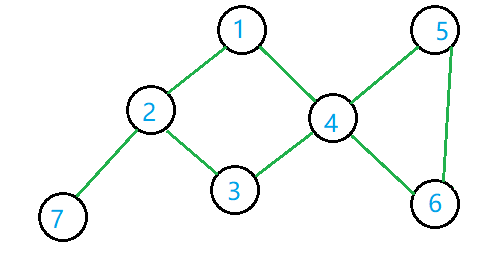
如图中的 $2,4$ 就是一个割点。
但需要注意的是,割点不一定在环上,比如:

图中的 $2$ 就是割点。
不过存在特殊情况:
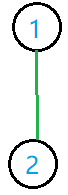
该图没有割点,无论去掉 $1$ 还是 $2$,最后都会剩下一个节点。
关于“割点”不同的定义
如同平衡树中的“左旋”与“右旋”,割点的定义也有不同的说法。(上文是主流说法)
比如说第三张图中只有两个节点,有人认为这两个都是割点,即剩下的那个节点不连通。
无向图 Tarjan 求割点
前置知识
无向图 Tarjan 求割点
前向边与横边不存在
见此处。
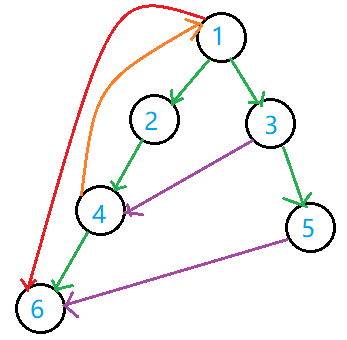
一棵有向图的 DFS 生成树如图:
图中绿色为普通树边,橙色为回溯边,红色为前向边,紫色为横边。
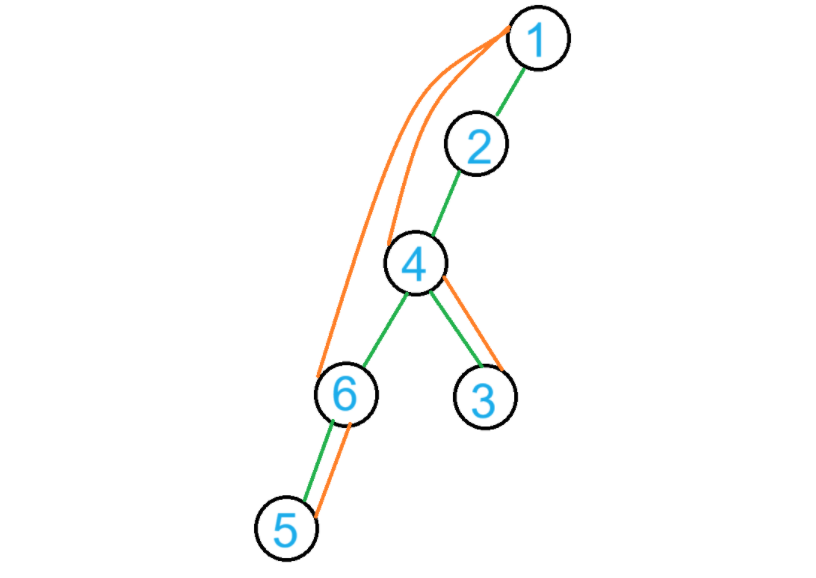
考虑到无向图,实际上 DFS 生成树中只有普通树边和回溯边。
前向边不存在,因为无向,因此前向边反向就是一条回溯边。
横边不存在,因为按照 DFS 搜索顺序不会使其有可能存在。
例如图中搜索到 $4$ 之后,按照 DFS 的原则会先后搜索 $3,6$,不可能只搜索 $6$ 然后回退至 $1$ 再搜索到 $3$,然后连横边。
即化为:
一定不为割点的情况
当该节点是 DFS 生成树的叶节点或只有一个子节点的根节点。
- 叶节点显然不影响生成树的连通。
- 根节点如果只有一个子节点,那么该子节点可以成为新的根节点,不影响连通。
割点的判定
以下讨论均在 DFS 生成树上。
令节点 $x$ 的子节点为节点 $y_1,y_2,y_3,\cdots,y_k$,则删除节点 $x$ 后其所在连通块会分裂为 $k+1$ 个部分:$y_1,y_2,y_3,\cdots,y_k$ 和父节点及其子树。
那么我们需要判断的就是能否使其分裂为至少 $2$ 个部分。
- 当节点 $x$ 为根节点时,需要分裂出至少两个符合以下规定的部分。
- 因为父节点的部分肯定是能够分裂出来的,因此当 $x$ 不为根节点时,需要分裂出至少一个符合以下规定的部分。
由于 DFS 生成树的性质,$\textit{dfn}_{y_i}$ 肯定是大于 $\textit{dfn}_x$ 的。
那么 $\textit{low}{y_i}$ 初始时为 $\textit{dfn}{y_i}$ 也大于 $\textit{dfn}_x$。
因此若求出来的 $\textit{low}_{y_i}\geq\textit{dfn}_x$,则代表其是节点 $x$ 的子节点部分,即不能回退到更高的地方。
但是存在一个问题:如果只需要分裂出一个很好判断,然而当 $x$ 为根节点时需要判断两个,如何判断 $y_i$ 之间有没有连接呢?
不需要判断,$y_i$ 之间绝对没有连接。
由无向图,不存在横边,因此 $y_i$ 之间想要连接只能够通过公共祖先,然而 $x$ 为根节点是其子节点的唯一公共祖先。
因此当 $x$ 为根节点时,$y_i$ 之间不会相连。
子节点数 son 计算代码:
1
2
3
4
5
6
7
if(!dfn[i]){
    Tarjan(i,root);
    low[x]=min(low[x],low[i]);
    if(low[i]>=dfn[x]){
        son++;
    }
}
答案记录:
1
2
3
4
5
6
7
8
9
if(x==root){
    if(son>=2){
        ans.push_back(x);
    }
}else{
    if(son>=1){
        ans.push_back(x);
    }
}
例题 AC 代码
1
2
3
4
5
6
7
8
9
10
11
12
13
14
15
16
17
18
19
20
21
22
23
24
25
26
27
28
29
30
31
32
33
34
35
36
37
38
39
40
41
42
43
44
45
46
47
48
49
50
51
52
53
54
55
56
57
58
59
60
61
62
63
64
65
66
67
68
69
70
71
72
73
74
75
76
77
//#include<bits/stdc++.h>
#include<algorithm>
#include<iostream>
#include<cstring>
#include<iomanip>
#include<cstdio>
#include<string>
#include<vector>
#include<cmath>
#include<ctime>
#include<deque>
#include<queue>
#include<stack>
#include<list>
using namespace std;
constexpr const int N=2e4;
int n;
vector<int>g[N+1];
int dfn[N+1];
vector<int>ans;
void Tarjan(int x,int root){
	static int cnt,low[N+1];
	dfn[x]=low[x]=++cnt;
	int son=0;
	for(int i:g[x]){
		if(!dfn[i]){
			Tarjan(i,root);
			low[x]=min(low[x],low[i]);
			if(low[i]>=dfn[x]){
				son++;
			}
		}else{
			low[x]=min(low[x],dfn[i]);
		}
	}
	if(x==root){
		if(son>=2){
			ans.push_back(x);
		}
	}else{
		if(son>=1){
			ans.push_back(x);
		}
	}
}
int main(){
	/*freopen("test.in","r",stdin);
	freopen("test.out","w",stdout);*/

	ios::sync_with_stdio(false);
	cin.tie(0);cout.tie(0);

	int m;
	cin>>n>>m;
	while(m--){
		int u,v;
		cin>>u>>v;
		g[u].push_back(v);
		g[v].push_back(u);
	}
	for(int i=1;i<=n;i++){
		if(!dfn[i]){
			Tarjan(i,i);
		}
	}
	sort(ans.begin(),ans.end());
	cout<<ans.size()<<'\n';
	for(int i:ans){
		cout<<i<<' ';
	}

	cout.flush();

	/*fclose(stdin);
	fclose(stdout);*/
	return 0;
}